Table of Contents
A prophecy, a portrait, and a bicycle journey across eight countries
P.K. Mahanadia’s life story, famously known as the tale of the man who cycled from India to Sweden for love, is stranger than fiction. Its complex narrative architecture has eluded filmmakers for decades.
In December 1975, a young Swedish woman named Charlotte Von Schedvin approached a street artist at Connaught Place in New Delhi. She wanted a portrait. What she got was a marriage proposal based on a prophecy made at the artist’s birth, twenty-six years earlier.
P. K. Mahanandia, born into a Dalit family in rural Odisha, had been told by a village astrologer that his wife would find him. She would be a Taurus. She would play the flute. She would own jungles. When Charlotte sat before his easel that winter evening, Mahanandia’s hands trembled. He asked her three questions. She answered yes to all of them.
This is not the opening of a film. It is real life. And yet it follows the structural logic of classical screenwriting so precisely that filmmakers have been circling the story for years, unable to quite capture it.
What makes this story so difficult to adapt?
The man who cycled from India to Sweden for love has inspired multiple adaptation attempts. Sanjay Leela Bhansali reportedly attempted a feature film titled Izhaar with Shah Rukh Khan around 2013. It never materialised. In 2025, Priyanka Chopra came on board as executive producer for The Cycle of Love, a documentary directed by Oscar-winner Orlando von Einsiedel. The fictional adaptation remains unmade.
The problem, I suspect, is structural. The story’s most cinematic element, Mahanandia’s four-month bicycle journey from Delhi to Sweden in 1977, occurs after the romantic tension has already been resolved. He and Charlotte had married by tribal custom before she left India. The journey is not about winning her love. It is about reuniting with a love already won.
This inverts the traditional romantic arc. In most love stories, the grand gesture precedes the union. Here, the union precedes the grand gesture. A screenwriter adapting this material must either restructure the timeline or find a way to sustain tension through a journey whose outcome is never in doubt.
How does prophecy function as dramatic setup?
The prophecy given at Mahanandia’s birth operates as a first-act plant that pays off with almost mechanical precision. A Taurus. A musician. A forest owner. Charlotte Von Schedvin, born in May, a flute player and music teacher, whose aristocratic Swedish family owned forests for three hundred years.
In fiction, such neat alignment would risk feeling contrived. In life, it carries the weight of the uncanny. The screenwriter’s challenge is to present this information without making the audience feel manipulated. The prophecy must feel like fate, not convenience.
Per J. Andersson’s book, The Amazing Story of the Man Who Cycled from India to Europe for Love, handles this by front-loading Mahanandia’s childhood and the caste discrimination he faced. By the time Charlotte appears, the prophecy has accumulated emotional weight. It is not just a prediction fulfilled. It is a promise that suffering will end.
What does the journey reveal about character?
Mahanandia sold everything he owned, bought a second-hand Raleigh bicycle for sixty rupees, and set off with eighty dollars hidden in his belt. He cycled through Pakistan, Afghanistan, Iran, and Turkey. He sketched portraits for food and shelter. He slept under the stars by the Caspian Sea. He arrived in Sweden with more money than he had started with.
The journey, narratively, functions less as rising action and more as character revelation. We already know he will reach Charlotte. What we learn is who he is: resourceful, trusting, sustained by art and by letters from the woman waiting for him. In Herat, he befriended an Afghan artist in love with his student, a woman whose father would kill them both if they married. Mahanandia advised him to run. Years later, after the Soviet invasion, he learned the man had done exactly that.
These encounters along the road are the story’s emotional texture. They are also its greatest adaptation challenge. Each one is a short film in itself, a detour from the central plot that enriches without advancing.
Why does this story resist the Bollywood treatment?
Nearly fifty years after the man who cycled from India to Sweden for love completed his journey, the definitive film version remains unmade. Bhansali’s signature is opulence, tragedy, and star-crossed lovers separated by circumstance. Devdas, Bajirao Mastani, Padmaavat. Mahanandia’s story shares the cross-cultural romance and the impossible odds, but lacks the tragedy. He and Charlotte have been married for nearly fifty years. They raised two children in Sweden. He became an art and culture adviser to the Swedish government.
Bhansali wrote a screenplay. The project stalled. Now a documentary, The Cycle of Love, is in production with Priyanka Chopra as executive producer and Oscar-winner Orlando von Einsiedel directing. The story keeps pulling filmmakers back.
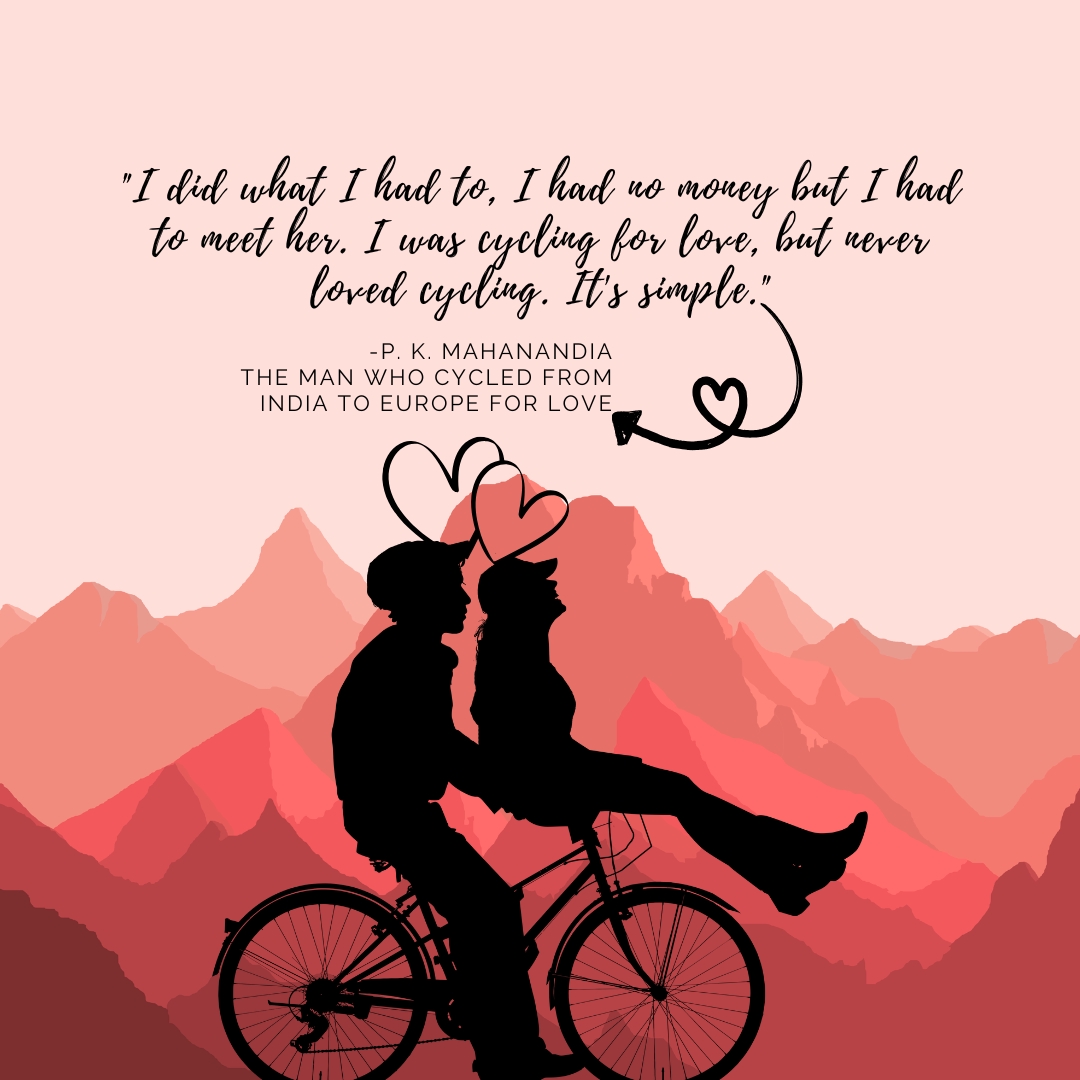
Mahanandia himself has offered the simplest explanation for his journey. “I was cycling for love, but never loved cycling. It’s simple.”
Perhaps that is the point. The simplest love stories are the hardest to tell because there is nothing to explain away.
Another 5 minutes read?
https://georgyabraham.com/manuscript/the-circular-mind-of-anantaram-2020/