The Labor market impacts of AI Chart Everyone Is Misreading
Anthropic published research last week that sent predictable tremors through the commentariat. The findings were framed as a warning: white-collar workers face significant AI exposure. ARK Invest’s Cathie Wood called Claude a “true PC moment”. The doomsday essays multiplied.
But the actual data tells a different story.
“Labor market impacts of AI: A new measure and early evidence.” Anthropic Research, March 2026. https://www.anthropic.com/research/labor-market-impacts
Anthropic’s Figure 2 maps two things: theoretical AI capability (what LLMs could do) and observed AI exposure (what they actually do). The gap between them is vast. Computer and maths occupations show 94% theoretical coverage, but only 33% observed exposure. Legal, architecture, engineering, education, arts, and media all show massive theoretical penetration with minimal real-world displacement.
This is not a chart of impending doom. It is a chart of breathing room.
What’s stopping AI from automating white-collar work?
The researchers themselves attribute this to legal constraints, model limitations, the need for additional software tools, and the requirement for human review. These are not temporary bugs. They are features of responsible AI deployment that will persist.
The EU AI Act now mandates AI literacy training for employees. Gartner predicts half of organisations will require “AI-free” skills assessments by 2026. Governance frameworks are emerging that explicitly require human oversight. The regulatory moat is real.
Then there are the physical realities. Installation, repair, construction, grounds maintenance, and production categories show near-zero observed AI exposure. Ford CEO Jim Farley put it bluntly: AI will replace many white-collar workers, but someone still needs to put up power lines, build factories, and lay water systems. First-line supervisors of mechanics face just a 0.003 probability of automation. Wages in construction and mechanical trades have climbed 30-40% since 2020, outpacing most office sectors.
Is AI actually making workers more productive?
Despite breathless claims, macro-studies of productivity growth find limited evidence of significant AI impact. The San Francisco Fed reports that even firms claiming AI is useful show little evidence of transformative gains. The Penn Wharton Budget Model projects AI’s peak contribution to annual productivity growth at just 0.2 percentage points in 2032.
Generative AI currently saves workers time equivalent to around 1.6% of total work hours. That is augmentation, not replacement. And this gradual adoption gives workers time to adapt, upskill, and transition.
Who benefits most from AI in the job market?
Here is where the narrative flips entirely. PwC’s analysis shows workers with advanced AI skills earn 56% more than peers in the same roles without those skills. The World Economic Forum reports 85% of employers plan to prioritise workforce upskilling by 2030. Job postings for AI engineers rose 143% year-over-year in 2025.
This is not a story of elimination. It is a story of differentiation. The opportunity is to ride the wave, not be drowned by it.
Is there evidence of AI-driven unemployment?
Anthropic’s own findings state there has been no systematic increase in unemployment for highly AI-exposed workers since late 2022. The researchers found only suggestive evidence that hiring of younger workers has slowed slightly in exposed occupations, and even that finding is barely statistically significant.
Richmond Fed President Thomas Barkin captured it well: we immediately jump to displacement and forget that people are going to be enabled. Kansas City Fed President Jeffrey Schmid added that AI will need to supplement the declining new entrants into the labour market.
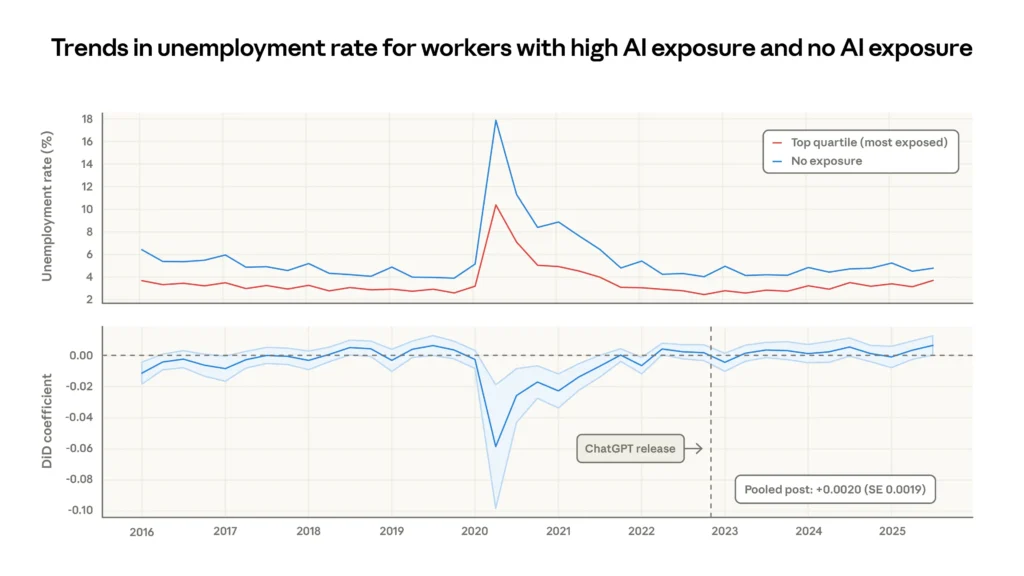
The top panel shows the unemployment rate for workers in the top quartile of exposure (red line) and the 30% of workers with zero exposure. The bottom panel measures the gap between these two series in a difference-in-differences framework. (Courtesy: Anthropic)
What should workers do about AI right now?
The chart meant to warn us of AI’s capabilities instead reveals its limitations. The red zone of actual adoption is a fraction of the blue zone of theoretical capability. Healthcare support, protective services, food service, personal care, sales, agriculture, construction, and skilled trades all sit in minimal disruption zones.
This does not mean change is not coming. Some roles will transform. But the “white-collar bloodbath” narrative requires ignoring the actual data in favour of theoretical projections.
The personal computer did not end work. It created entirely new categories of it. The same trajectory is unfolding now. The question is whether we panic or prepare. The chart suggests we have more time than the headlines claim.