Table of Contents
The game has shifted. Organic CTRs for queries featuring AI Overviews have dropped 61% since mid-2024. Even on queries without AI Overviews, organic CTRs fell 41%. Users are clicking less everywhere, and the traditional logic of ranking high, getting clicks, and driving traffic is breaking down. The SEO consensus layer is where visibility is now won or lost.
What is the SEO consensus layer?
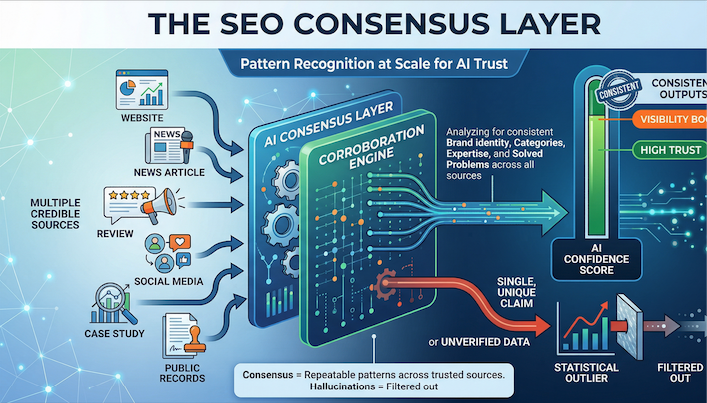
Think of the consensus layer as the degree to which multiple AI systems produce consistent, repeatable outputs about your brand. It is about pattern recognition at scale.
When AI systems encounter your brand described the same way across multiple credible sources, in the same category, with the same expertise, and with the same problems you solve, they build confidence. When they do not see that pattern, you become a statistical outlier. Outliers get filtered out.
This happens because AI systems are engineered to prevent hallucinations. Their primary defence is corroboration: if multiple independent sources say the same thing, the AI assigns higher confidence to that claim. If only one source says it, the AI becomes cautious or ignores it entirely.
Why does traditional SEO fail in the consensus layer?
Traditional SEO operated on a retrieval-based model. Google found pages and users chose which ones to visit. AI-driven search does not work that way. Systems like Google’s AI Overviews, ChatGPT, and Perplexity are now constructing answers. They pull from dozens of sources, identify which claims appear consistently across credible publishers, and synthesise a single response.
The technical engine behind this is retrieval-augmented generation, or RAG. These systems do not rank your page against competitors. They evaluate whether your brand’s claims are corroborated across the web. If you have one excellent page but no supporting mentions elsewhere, you are invisible.
This is the fundamental shift. A single high-ranking page used to be enough. Now, you need distributed authority.
How do you build visibility in the SEO consensus layer?
As Google’s Danny Sullivan said, “Good SEO is good GEO.” The fundamentals have not disappeared, but they are now table stakes, not differentiators.
The new formula is: authority + consensus + distribution. This means integrating SEO, digital PR, and community engagement into one cohesive strategy.
The goal is to build a distributed network of authority, mentions, citations, and community validation. This takes time to construct and is nearly impossible for competitors to dismantle overnight. That is the visibility moat worth building.
Here is what this looks like in practice. Your owned content states a clear position. Your earned media reinforces that position through press coverage and third-party mentions. Your community presence on platforms like Reddit, LinkedIn, and industry forums echoes the same narrative. When an AI system encounters your brand across all three channels with consistent messaging, it trusts you.
What happens if you ignore the consensus layer?
LLMs are binging on a diet of earned media. Press releases, social media content, user-generated content, your website, your retailers’ sites, YouTube videos, and Reddit threads all have a huge influence on the topic ecosystems that LLMs use to develop their understanding of your brand.
If you are only optimising your own website, you are optimising for a shrinking share of visibility. The brands winning in 2026 are those who recognised early that AI does not just read their website. It reads everything written about them, everywhere.
When AI search is generating answers, it is looking for a consensus across the web to validate facts. This is where your SEO strategy must merge with your PR and communications efforts to influence the sources the AI trusts most.
The shift moves from old-school link building to narrative building. Instead of chasing a high volume of backlinks to boost domain authority, you are now chasing high-value citations to build brand mentions and authority in specific spaces.
What does the consensus layer mean for B2B brands?
For B2B companies, the SEO consensus layer presents both a challenge and an opportunity. The challenge is that B2B brands often have limited earned media coverage compared to consumer brands. The opportunity is that the consensus layer rewards specificity and expertise.
If you can establish your brand as the consistent answer to a narrow, high-intent query, you win that space. The AI does not need you to be everywhere. It needs you to be consistently present in the places that matter for your topic.
This means understanding where your ideal clients search, not just on Google, but across the platforms that inform AI systems. YouTube, Reddit, Quora, and others dominate significant portions of traditional search results and may have far more search activity within their own platforms. When AI systems generate answers, they often pull information from these platforms rather than brand websites.
What should you do now?
The SEO consensus layer is not a future state. It is the current state. The 61% CTR drop is already here. The brands adapting are building narrative consistency across owned, earned, and community channels. The brands still chasing rankings alone are losing ground daily.
The clock is ticking.
Source Attribution: Adam Heitzman, “SEO’s new battleground: Winning the consensus layer”, Search Engine Land, March 2026. Jen Cornwell, “Why 2026 is the year the SEO silo breaks and cross-channel execution starts”, Search Engine Land
Let me grab your attention to another 5 minutes post.
Winning Against the Big Players: 5 SEO Lessons for Challenger Brands