Most print-on-demand brands follow the same playbook. Create designs, sign-up on a Print of Demand store, host an e-commerce website on shopify, run Meta ads, pray for virality, repeat. I wanted to test whether a different approach could work.
Heritage Glitch is my brand. Premium art parody t-shirts on 240 GSM super-combed cotton. I soft launched it in late January 2026 with ten designs, deliberately small, deliberately quiet. The website is still being reworked based on early customer feedback. Some designs are archived, others being refined. A proper full-scale launch comes later.
But the SEO, AEO, GEO and AIO groundwork started from week one.
The Hypothesis
Every T-shirt brand in India competes on design. Funny quotes, trending memes, fandom prints. The designs get copied within 48 hours. There is no moat.
I wanted to build a moat around something harder to replicate: topical authority on product quality.
Heritage Glitch uses 240 GSM fabric, significantly thicker than the 180 GSM industry standard. When I analysed search behaviour, I found something interesting. People searching for GSM-related queries were not textile students or researchers. They were quality-conscious buyers in the consideration phase. The kind willing to pay a premium for a t-shirt that lasts.
Almost no Clothing brand in India was creating educational content around this. The gap was wide open.
The Execution
The first three weeks went into website development, collecting feedback from early customers, and refining the product line. The content push came later.
I mapped the buyer journey into stages:
- Awareness: What does 240 GSM even mean?
- Consideration: Is it worth the extra cost? Will it suit Indian weather?
- Decision: Which brands actually sell 240 GSM?
- Purchase: Direct site visit
Rather than chasing transactional keywords from the start, I focused on owning stages one and two. Six blog posts went live on 22nd February, all centred on 240 GSM education. What it means, how it compares to 180 GSM, how to verify quality in-store, whether it works for Indian summers, and a comparison of brands in the market.
The logic: if someone learns about fabric quality from Heritage Glitch at the awareness stage, they are more likely to trust and buy from Heritage Glitch at the decision stage.
What Happened Next
The results came faster than expected.
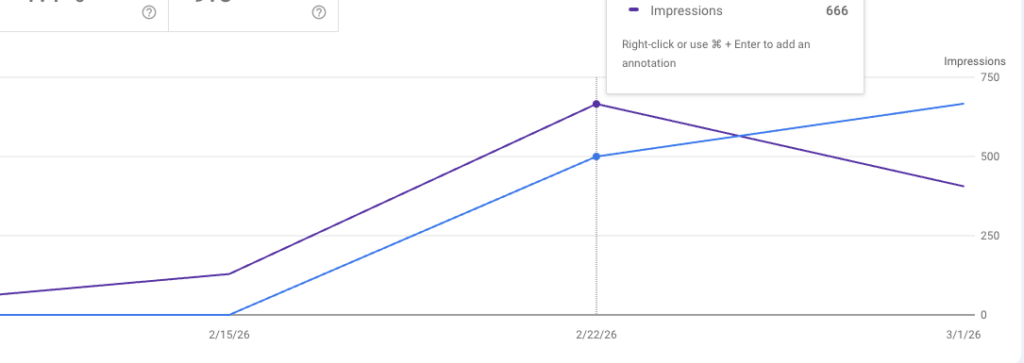
Within 48 hours of publishing, impressions spiked. All six posts indexed rapidly, and the site started appearing on page one for several educational queries around fabric weight and t-shirt quality. The graph speaks for itself.
What I did not anticipate: the site began ranking for broader queries like best t-shirt brands in India, without any content optimised for that phrase. Google was already associating Heritage Glitch with premium quality based on the topical cluster alone.
Stages one and two, awareness and consideration, were effectively covered within days, not months.
What Comes Next
The foundation is set faster than planned. The next phase is building the bridge to stages three and four: commercial intent content that converts consideration into purchase, and driving direct site visits.
I will be documenting this as a series. The next update will cover the conversion layer, what worked, what didn’t, and whether this approach can actually drive revenue for a bootstrapped E-commerce clothing brand.
The full Heritage Glitch launch is coming soon. Until then, the experiment continues.
Visit Heritage Glitch: https://www.heritageglitch.in