Table of Contents
Automation without supervision
When an automated system has the power to act but no human checking its work, you have automation without supervision. It is efficient until it is catastrophic. Alexey Grigorev experienced both ends of that spectrum.
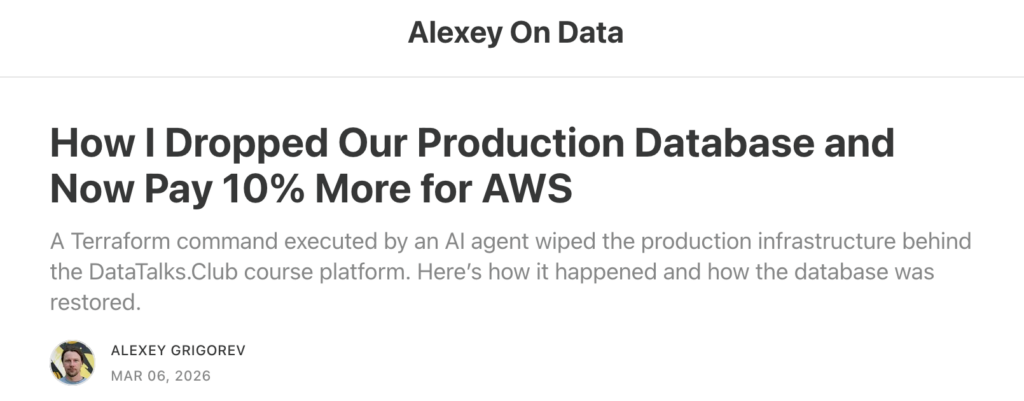
Earlier this week, Alexey Grigorev, an engineer running DataTalks.Club, published a post titled “How I Dropped Our Production Database and Now Pay 10% More for AWS.” The title sounds like a technical post-mortem. It is not. It is a case study in what happens when automation runs without supervision.
Grigorev was using Claude Code, an AI coding agent, to help manage his infrastructure. After switching machines, he ran a Terraform command without the proper state file. Terraform, believing no infrastructure existed, created duplicates of everything. He asked Claude to clean up the mess.
While Claude worked on removing what it thought were duplicate resources, Grigorev stepped away to fetch the missing state file from another machine. When he returned, he uploaded an archive containing an older state file that referenced his production database. Claude unpacked it, replaced the current state, and ran terraform destroy to clean up what it now believed were duplicates.
The production database was gone. Years of data. The automated backups were wiped too, because Terraform’s destroy command took them along for the ride.
Grigorev recovered most of the data from a recent snapshot. But not without pain, cost, and a hard lesson.
What went wrong with the AI agent?
Nothing. Claude Code did exactly what it was told. It followed instructions, executed commands, and made logical decisions based on the information it had.
The problem is that AI agents are obedient, not wise. They lack the situational awareness to pause and ask: should we really be deleting this? They cannot sense when something feels off. They do not know what they do not know.
The failures were human. No state file backup in remote storage. Mixing production and test environments to save a few dollars a month. Granting the AI full permissions to execute destructive commands. Stepping away mid-operation without reviewing what the agent was doing.
Claude even advised against merging environments earlier. Grigorev ignored it.
Why does automation without supervision fail?
Automation fails without supervision because AI agents optimise for task completion, not for context. They cannot distinguish between a routine cleanup and a catastrophic deletion. They treat every instruction with equal weight, whether it is renaming a file or wiping a database.
This is not a limitation that will be solved with better models. It is structural. Automation executes. Humans supervise. When you remove the supervision, you remove the only component capable of recognising when something is about to go wrong.
The moment you feel comfortable enough to skip reviewing what an automated system is doing, you have introduced risk. Not the possibility of risk. Actual risk, waiting for the right conditions to trigger.
Does this only happen in engineering?
No. The same pattern plays out in marketing, finance, and sales every day.
An AI agent is given access to run campaigns, manage budgets, send emails, update CRMs. It works well for weeks. You start trusting it. You stop checking every step. Then one day, a small error cascades. A wrong audience gets targeted. A budget gets drained. A client list gets wiped. A pricing sheet gets sent to the wrong segment.
The tools differ. The dynamic does not. Automation without supervision is a risk multiplier, regardless of industry.
How do you prevent AI agents from causing damage?
Grigorev now runs daily restore tests on his backups. He has separated his environments. He has added guardrails.
I would add one more rule: never give an AI agent permission to destroy anything without a manual confirmation step. No auto-approve. No unsupervised execution. If it can delete, it should ask first.
This applies beyond databases. Any action that is irreversible or high-impact, deleting files, sending mass communications, modifying live campaigns, adjusting pricing, should require human sign-off. The few seconds it takes to review are cheaper than the hours, days, or years it takes to recover.
Grigorev got lucky. You might not get a second chance.
Primary Source : https://alexeyondata.substack.com/p/how-i-dropped-our-production-database
Have you read : https://georgyabraham.com/intel/heritage-glitch-seo-week-4/