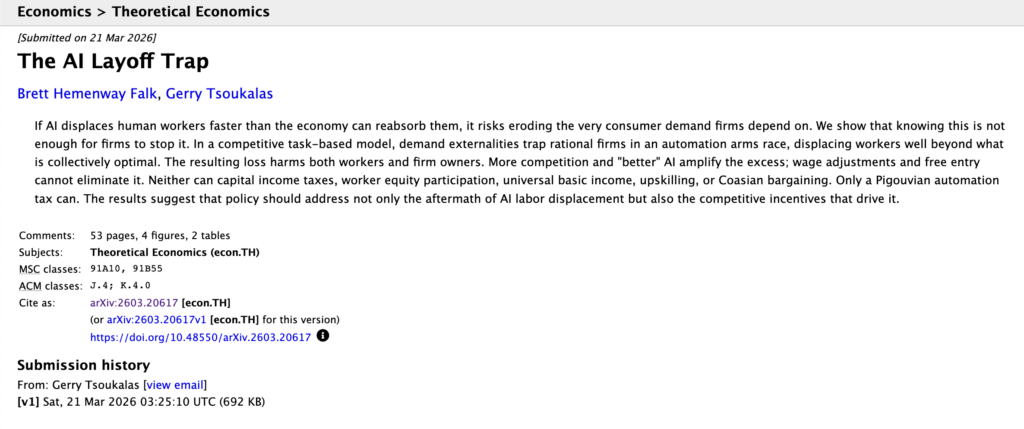
A March 2026 paper from UPenn and Boston University proves that companies will automate past the point of self-destruction, and no market force can stop them.
Table of Contents
What is the AI Layoff Trap?
A March 2026 paper titled ‘The AI Layoff Trap’ by Brett Hemenway Falk at the University of Pennsylvania and Gerry Tsoukalas at Boston University has formalised something many of us have sensed but could not articulate. When firms replace workers with AI, the cost savings stay with the firm. But the lost spending power spreads across the entire economy. Each company absorbs only a fraction of the demand it destroys. The rest falls on competitors.
The result is a demand erosion that is collective, gradual, and invisible until it is not.
This is not speculation. The paper cites Block’s February 2026 decision to cut nearly half its 10,000-person workforce, with CEO Jack Dorsey stating that AI had made many roles unnecessary. Over 100,000 tech workers were laid off in 2025, with AI cited as a primary driver in more than half the cases. Salesforce replaced 4,000 customer support agents with agentic AI. The mechanism the researchers describe is already operating.
Why can companies not stop the AI Layoff Trap even if they see it coming?
This is the most chilling part of the paper. The authors are not arguing that firms do not understand the consequences. They are arguing that understanding changes nothing.
Any firm that slows its automation loses ground to competitors that do not. The cost savings from replacing a worker are immediate and captured entirely by the automating firm. The demand destruction is diffuse, shared across every business in the market. Rational actors, with full information, produce a collectively irrational outcome.
The paper tested every popular solution against this problem. Universal basic income. Upskilling. Worker equity. Capital taxes. Wage adjustments. None of them fix the core incentive. The only intervention the model supports is a Pigouvian tax on automation itself, a per-task charge that forces every company to pay for the demand it destroys when it fires a worker.
That is how broken the feedback loop is.
What does the AI Layoff Trap mean for B2B sales pipelines?
Here is where this paper stops being an economics discussion and starts being a sales strategy problem.
Who buys B2B products? Companies staffed by people. Who are those people? Increasingly, former employees replaced by AI. At some point, your ICP does not have a budget because your ICP does not have a payroll. The automation that cut your client’s costs just cut your addressable market.
The pipeline does not dry up dramatically. It thins, quietly, one displaced buyer at a time. The mid-management roles that used to evaluate your product, the operations teams that used to implement it, the customer support staff that used to escalate issues to decision-makers, these are the first roles being eliminated. And when they go, so does your point of contact.
Why should Indian businesses pay attention to the AI Layoff Trap?
India’s IT and services sector is disproportionately exposed. Customer support, operations, and middle management are the roles being cut first globally. These are precisely the roles Indian white-collar workers occupy in large numbers, both domestically and in global delivery centres.
The numbers are already visible. TCS announced its largest-ever layoffs in 2025, cutting around 12,000 roles and citing AI-driven skill mismatches. A NITI Aayog report from October 2025 warned that in a worst-case scenario, the tech services sector headcount could decline from 7.5 to 8 million in 2023 to 6 million by 2031. The customer experience sector could fall from 2 to 2.5 million to 1.8 million. Over 60 per cent of formal sector jobs are susceptible to automation by 2030, particularly in IT and BPO.
This paper is not abstract for India. It is a countdown.
What should B2B leaders take from this research?
The question for Indian business leaders is not whether AI is useful. It clearly is. The question is whether we are building long-term market capacity or systematically dismantling the consumer base that sustains it.
A race no one can exit is not progress. It is just a faster route to the same cliff.
Another 3 minutes read : AI Recession Debunked: 5 Findings from Anthropic’s Own Research